Soundbytes 10.2
Real Good Bear

THINKING BACK ON WHAT WE’VE DONE AND MADE AND BEEN in our lives, how much do we get right?
For me, this includes the childhood recollections that were colored by my mother who inflated everything, and my old man who did the opposite. For instance, I remember playing with a whisk broom. My mother’s version: “You could make anything into a toy, bless your little heart.” My old man’s: “Buying you toys was throwing good money away.”
Not too much to be done about those—we don’t get much choice about the stories planted in us as children.
But aside from all the hard-wired bits, I think my particular noggin is just better at inventing than recalling. In contrast, my wife can remember all the lyrics to songs she heard around the campfire when she was fifteen. I can’t remember the lyrics to songs I have written. Compounding that, many memories that feel true are almost certainly only composites—bits and pieces of events that might have happened, could have happened, should have happened, or just happened to somebody else.
The genesis of this song, Real Good Bear, was a hike I definitely took with my old man. It was one of the last companionable experiences we shared before I began to wear bellbottom pants and grew long hair and married a Catholic girl, of all the boneheaded things to do, and he wrote me off.
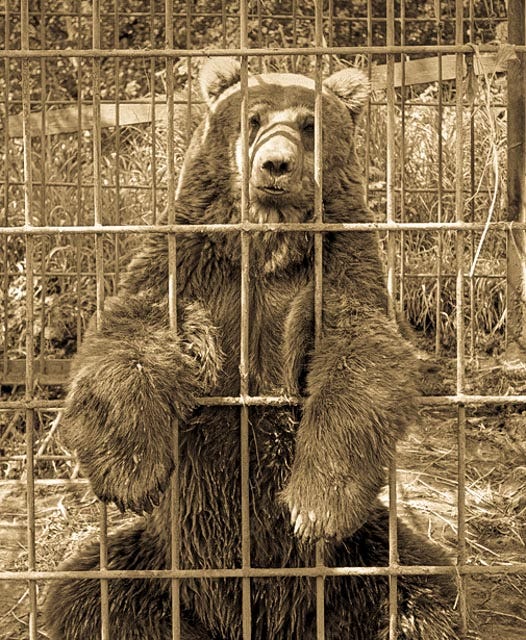
We were hiking the Glen Helen Nature Preserve in Ohio, enjoying the poison ivy and mosquitos. Coming up from the gorge to a little sunny clearing, we came upon a 6-foot brown bear standing in an iron cage. Honest, we did. The bear was enormous, eye to eye with my old man, threadbare and stinky, with yellow claws gripping the bars like a prisoner in a TV western who had been captured by a posse and tossed in the town calaboose.
Seriously, a bear. A big one. In a cage. Face to face with a bear of another kind, my old man.
The problem is this: the bear didn’t exist, couldn’t have existed, right? A bear in a cage in the woods: it makes no sense at all, then or now or ever. Or does it?
Yet I remember it. Clearly. So I wrote a song about it, and twisted the memory even further, and threw away the cage and the woods and my old man and added a bike and a parasol and a pair of checkered pants. Real Good Bear.
And you wonder why I don’t remember that fifty bucks you say I owe you.
Real Good Bear [click to play]
They taught the bear to juggle, taught him how to dance
Gave the bear a parasol and a pair of checkered pants
Sit up straight and clean your plate and say your prayers
You’re a real good bear.

He learned to paint by numbers and do the cha-cha-cha
And a bit of long division counting on his paws
Fetching in a tutu though his legs were kinda fat
And that’s a real good bear

   Good bear, good bear
   Good bear, good bear

Now no one likes a scaredy-pants, a whiner and a crier
So they taught him how to balance on a skinny little wire
And roar as if he meant it though his heart wasn’t it in
A real good bear

Now can you ride a mini-bike and bark your ABCs
And juggle for the company, then won’t you, pretty please
Just perfect to the letter, couldn’t be no better, you’re
A real good bear

They taught the bear to juggle, taught him how to dance
Gave the bear a parasol and a pair of checkered pants
And if they don’t adore you they’ll feel sorry for you
A real good bear, ain’t you
A real good bear
Philip Singer’s first chapbook, Natives (Chowder Press, Madison, WI) was followed by See Rock City (Gallimaufry Press, Bethesda, MD), poems first published in North American Review, Poetry Magazine, Swanee Review, Yale Review, Southern Poetry Review and other publications too obscure for even the author to remember. He also co-edited the regrettably short-lived New River Review (Radford, Virginia), with poet Charles L. Hayes, and Poetryfish (Norwich, Vermont), an online journal of poetry and fiction. Sun Tea, a serialized memoir first published here on Substack, appeared in 2022, with a couple of afterwords (Hey, kids, wait up!) in the years since.
Singer lives in Virginia with his wife Briah and their little gray wonder-dog, Maisie.